
5 Simple Ways to Identify an Original Madhubani Painting vs Fake Prints
Every year, thousands of buyers search for authentic Madhubani paintings online — but end up with a machine-printed copy shipped from a warehouse. The market is flooded with digital replicas that look "close enough" on a screen but are nothing like the real thing.
At KalaVihar, every painting is sourced directly from verified women artisans in Madhubani, Bihar. Before you spend your money anywhere, here are 5 expert-backed ways to identify an original Madhubani painting so you never get fooled again.
1. Check the Surface Material
Original Madhubani art is painted on handmade paper (Mithila paper), cloth (cotton/silk), or natural canvas. Fake prints are almost always on glossy photo paper or coated machine-cut sheets.
- Run your finger across the surface — real art has texture and slight unevenness from brush strokes.
- Glossy, perfectly smooth surface = printed copy.
- Handmade paper has visible fibers on the edges.
2. Look at the Lines — Are They Perfectly Uniform?
Madhubani painting is a hand-drawn tradition. Every line is made with a bamboo stick, twig, or brush dipped in natural pigment.
- Real paintings have slight wobble and variation in line thickness — that's the artisan's hand.
- If every line looks laser-precise and perfectly even, it's a print.
- Zoom in on photos: hand-done lines show small ink bleeds on textured paper.
3. Examine the Colors — Natural or Chemical?
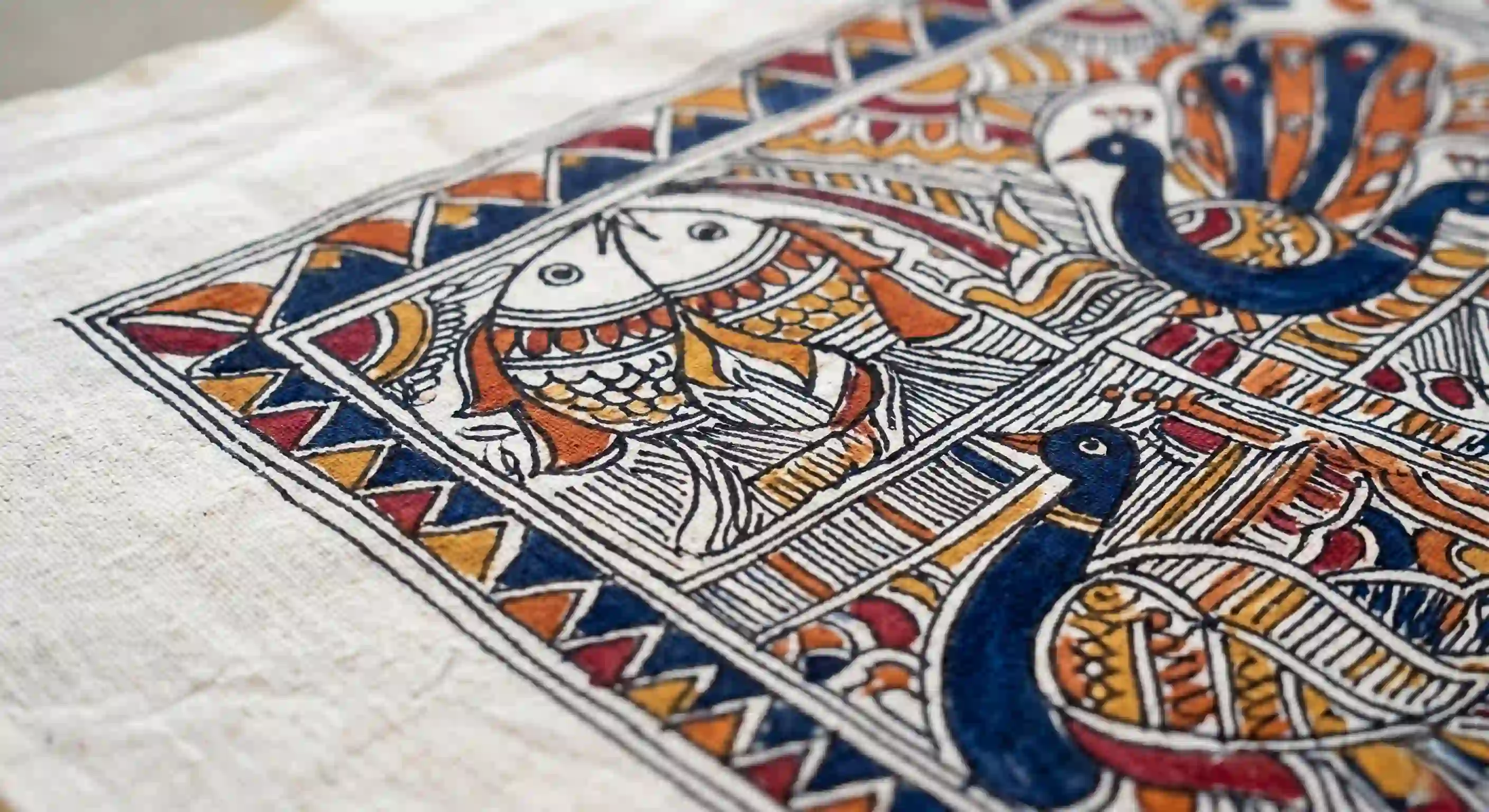
Traditional Madhubani artists use natural earth pigments — turmeric for yellow, indigo for blue, lac for red, and cow dung for black outlines. These colors have a characteristic slightly muted, earthy depth.
- Machine prints use neon-bright, hyper-saturated ink that looks almost plastic.
- Authentic pigments may show faint texture and layering when viewed at an angle.
- Over time, natural colors develop a beautiful patina — fake prints fade unevenly.
Pro Tip: Ask the Seller
A genuine platform like KalaVihar can tell you exactly which artisan painted a piece, which village they are from, and which natural materials were used. If a seller can't answer these questions, be skeptical.
4. Look for the Artist's Signature or Thumb Mark
In the Madhubani tradition, many artisans sign their work with their name in Devanagari script or a thumb impression on the back or corner of the painting. This is a mark of identity and pride.
- Check the back of the work for a handwritten note or signature.
- Printed copies never have this — they have only barcodes or blank backs.
- Some authenticated pieces come with a GI (Geographical Indication) tag for Mithila art.
5. Price Is a Strong Signal
A hand-painted Madhubani artwork — made over 3–7 days by a master artisan — cannot cost ₹200 or ₹300. If a price seems too good to be true, it is a print.
- Authentic small-size paintings (A4): ₹800 – ₹2,500+
- Medium works (A3): ₹2,500 – ₹7,000+
- Large/masterpiece works: ₹10,000 and above
Conclusion
Identifying an original Madhubani painting is about texture, lines, color depth, artist identity, and fair price. Real Madhubani art carries decades of tradition in every stroke — and the artisan who painted it deserves to be paid fairly for it.
At KalaVihar, we verify every artwork and every artist before listing — so you never have to wonder if what you're buying is real.